About Atabey
Atabey Sánchez-Haiman is a biologist, artist, and mindfulness teacher whose work integrates creative practice, scientific training, and trauma-sensitive mindfulness education. Her Giraffes + Robots Pop Art & Mindfulness Studio offers art, design, and mindfulness-informed neuroarts consultations and mentoring, bringing bright colors, whimsy, peace, and calm into spaces that were previously sterile or anxiety-producing. She is also a founding member of Brain Sparks Lab, an international collaborative of art and mindfulness professionals who brainstorm and create practices to make mindfulness accessible in daily living through engagement with public art, architecture, parks, train stations, offices, medical centers, museums, and more.
Atabey is trained to teach Mindfulness-Based Stress Reduction (MBSR, Brown University), Mindful Self-Compassion (MSC, Center for Mindful Self-Compassion), Mindfulness for Life (MBCT-L, Oxford Mindfulness Foundation), Deeper Mindfulness (Oxford Mindfulness Foundation), Introducing Mindfulness (Oxford Mindfulness Foundation), Mindful Habit Change (Judson Brewer/Robin Boudette, Mindshift), and Mindfulness in Art (Oxford Mindfulness Foundation).
She facilitates weekly live mindfulness sessions online at Mindshift Recovery (US) and Frazzled (UK), offering practices that support deep listening, mindful inquiry, and learning. Mindshift Recovery is a US nonprofit bringing neuroscience-based addiction recovery tools to anyone who needs them, free of charge, grounded in the reward-based learning research of addiction psychiatrist Dr. Jud Brewer, whose work sits at the intersection of mindfulness and neuroscience. Frazzled, founded in the UK by Ruby Wax, offers a free, non-judgmental community space for people navigating the stresses of modern life, built on the understanding that being heard and belonging to a community is itself a form of care. That both organisations offer their services freely is intentional, central to why she is there. Her work in these spaces is part of her commitment to making contemplative practice accessible, across culture, class, and circumstance.
Atabey is part of the teaching team for the Greater Good Science Center's Educators Program at UC Berkeley, which endeavors to translate the latest psychology, sociology, and neuroscience research of wellbeing and make it accessible to educators who would like to build kinder, more compassionate schools and classrooms where both students and adults can flourish. She also teaches Mindfulness-Based Ethical Living (MBEL) and is part of MBEL's curriculum and teacher training team. Developed by an international collaboration through the Secular Buddhist Network, MBEL takes mindfulness beyond personal practice into the ethical and relational dimensions of daily life, exploring what it means to live with care and response-ability in the world, bringing practice off the cushion and into how we act, relate, and show up for one another.
Atabey is the inventor of Mindfulness in Space, an original framework for the wellbeing of astronauts on long-duration missions. Its central idea: every voyage into outer space is also a voyage into inner space. As humans travel further from Earth, traveling inward may be an increasingly resourcing place of connection and wellbeing. The framework offers space explorers a way to meet distance, isolation, and homesickness with steadiness and compassion, a way of returning home while Earth moves farther away. Tuning into a sense of it through the knowing that every explorer's body is made of the same atoms as the soil, oceans, and air of the planet they left behind, Earth never stops being part of them, even at its farthest edge. Accessing and cultivating a felt sense of home through practices and conversations that cultivate a sense of home within. Always home, no matter how far they travel.
To meet the culture where it is, Atabey created The Mind Bimble (coming soon). The title intentionally draws on the British English word "bimble": to wander joyfully, without hurrying, with an open and curious awareness. The podcast wanders through art, mindfulness, and science in easeful conversation, open to whatever arises without the habitual cultural constrictions of academia, profundity, or perfectionism. An invitation instead, to let go of striving and try out something different, a Mind Bimble, and see where that takes you. The possibility of freedom from all the constriction that can be found in cultural expectations of value for money, value for time, and all those things that have flavors and connotations of consumerism and capitalism masquerading as value.
For Atabey, home is something carried within, regardless of distance. The distance to Mars, and the distance a person from a racialized community can feel from a culture that was not built with them in mind, are not so different in kind. She has created a ten-week program called Mindful Bias, Bridging and Belonging (MBBB), which draws on mindfulness, neuroscience, and contemplative practice to help participants recognize and work with the habit loops that underlie bias, and to cultivate the conditions for genuine bridging and belonging across differences. Running through every session is the UFTA and PFTA practice. Unpleasant and Pleasant Feeling Tone Arising Practice is Atabey's original application of the concept of feeling tones that she learned during Buddhist retreats and teachings as well as her Deeper Mindfulness teacher training. She developed UFTA and PFTA Practice as a tool for noticing and working with the moment of a feeling tone arising, curious within this felt experience across moments of craving, habit change, and the lived encounter with bias. MBBB is designed as a contribution to the broader mindfulness-based program landscape.
Puerto Rican and Spanish-speaking, she is committed to cultivating cultural humility and to creating spaces where racialized communities can disentangle these narratives about race, worth, and belonging, through art, mindfulness, neuroscience, ethics, and habit change. She sees mindfulness as active, compassionate engagement that can transform cultures dominated by greed and hatred, shifting intentionally toward integrity, ethics, and values. Releasing the cultural habit of seeking external validation, and learning instead to rest in an internal sense of worth grounded in values and integrity. Turning toward love and flourishing, toward lives that are honest, value-aligned and peaceful, wherever we are.
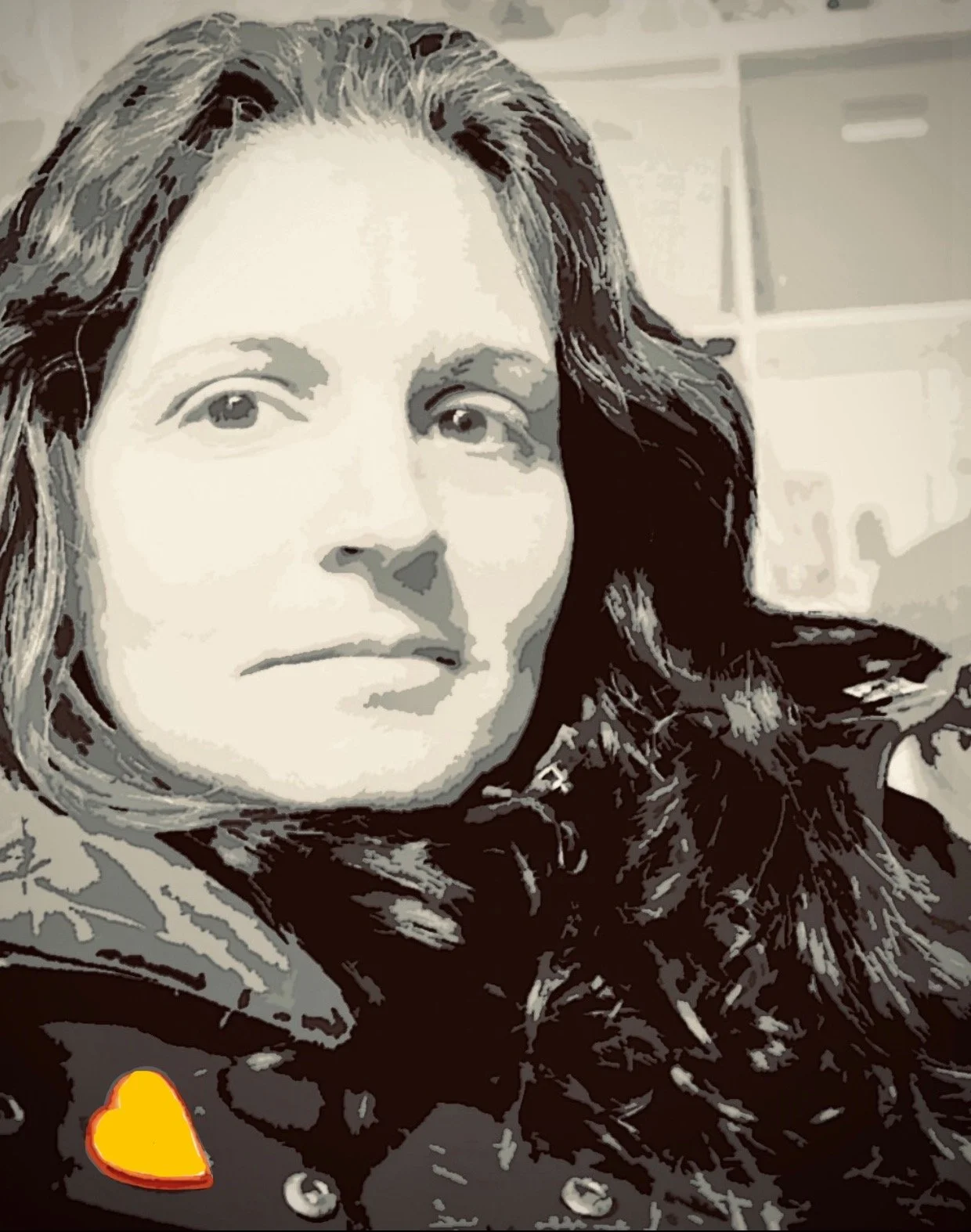
“Since I was little I wanted to be an astronaut. This plan lasted
throughout university and beyond . While at university, (I have a Biology degree from Brown University) I had a lot of friends from RISD, an art school nearby. I would study my neuroscience textbooks while they painted, sculpted, printed, etc. I loved the science I was learning but I was also in awe of their completely different university experience. I was spending all my time in labs, they were spending all their time in studios. That artistic lifestyle was so foreign to me and also extremely interesting. Like a studio, a lab can be a very creative and fun place to be, but there is something about the spontaneous creativity of a studio that stayed with me.
My plan to become an astronaut was still first priority throughout my studies. I enjoyed being a tourist at my friends’ art studios, but my place was in the lab. I found neuroscience fascinating and as interesting as space, so many things to discover. So, my passion for science continued to be my main focus. I love the feeling of discovering the unknown. Space, the brain, how organisms work. Science is one unchartered territory after another and I really enjoy the process of discovery.
Then one summer during my studies, I took a trip to Japan. It was during that trip to Japan that I realized what exciting and wonderful worlds I had to discover outside of labs. As soon as I graduated, instead of applying to NASA, or spending my time in a neuroscience lab, I decided I wanted to travel the world instead. My home has been in many countries across the globe ever since.
While living in Barcelona, I fell in love with the way the city lives and breathes art. I was reminded of my artist friends and their lifestyles and had a chance to revisit that world. But this time I wasn’t content with just being a tourist in that world. So, one day I spontaneously went into a little corner art store and bought a blank canvas, some paintbrushes and an acrylic starter set. I went back to my apartment to see what being an artist felt like. I loved it. I painted constantly and became fast friends with the woman at the corner art store. I was addicted and she supplied me with all the necessary tools and advise that a novice like me needed to express my newfound creative drive in this new world. Sometimes, I would be so into a painting that the sun would come up and I would realize I forgot to sleep. I was able to finally explore that studio/art world that I had been captivated by years earlier but had thought was unattainable.
After two years spent painting daily in Barcelona, I became an artist. And I have been painting giraffes and robots ever since. I still consider myself a scientist too. Art and Science are both parts of who I am and I think that my science background positively influences my artwork. Many express surprise at the switch from science to art, but I believe that art and science complement each other beautifully. My studio is full of tins, jars, souvenirs, boxes, toys, papers, postcards, illustrations, books, photos and many other items I’ve collected during my travels. All are sources of inspiration for my work.
During the pandemic pause, I started training to teach mindfulness at Brown University, The Oxford Mindfulness Foundation and The Center for Mindful Self Compassion. After 5 years of full time study and immersion into mindfulness and the neuroscience of mindfulness, I am now a teacher of MSC (Mindful Self Compassion), MBSR (Mindfulness Based Stress Reduction), Mindful Habit Change (Judson Brewer's addiction recovery program), MBCT-L (Mindfulness for Life), Deeper Mindfulness and Mindfulness in Art.
Yeah, I know, that is a lot! But once I started going down this path of learning how the brain works and how mindfulness interventions can heal, offer nourishment and peace and can help people break free from the entanglement of addictions, I was motivated to keep learning. I am still learning, and also teaching and facilitating groups for non profits in the US and in the UK.
I am, in a way, an astronaut after all because I discover and explore new inner and outer worlds everyday.”